
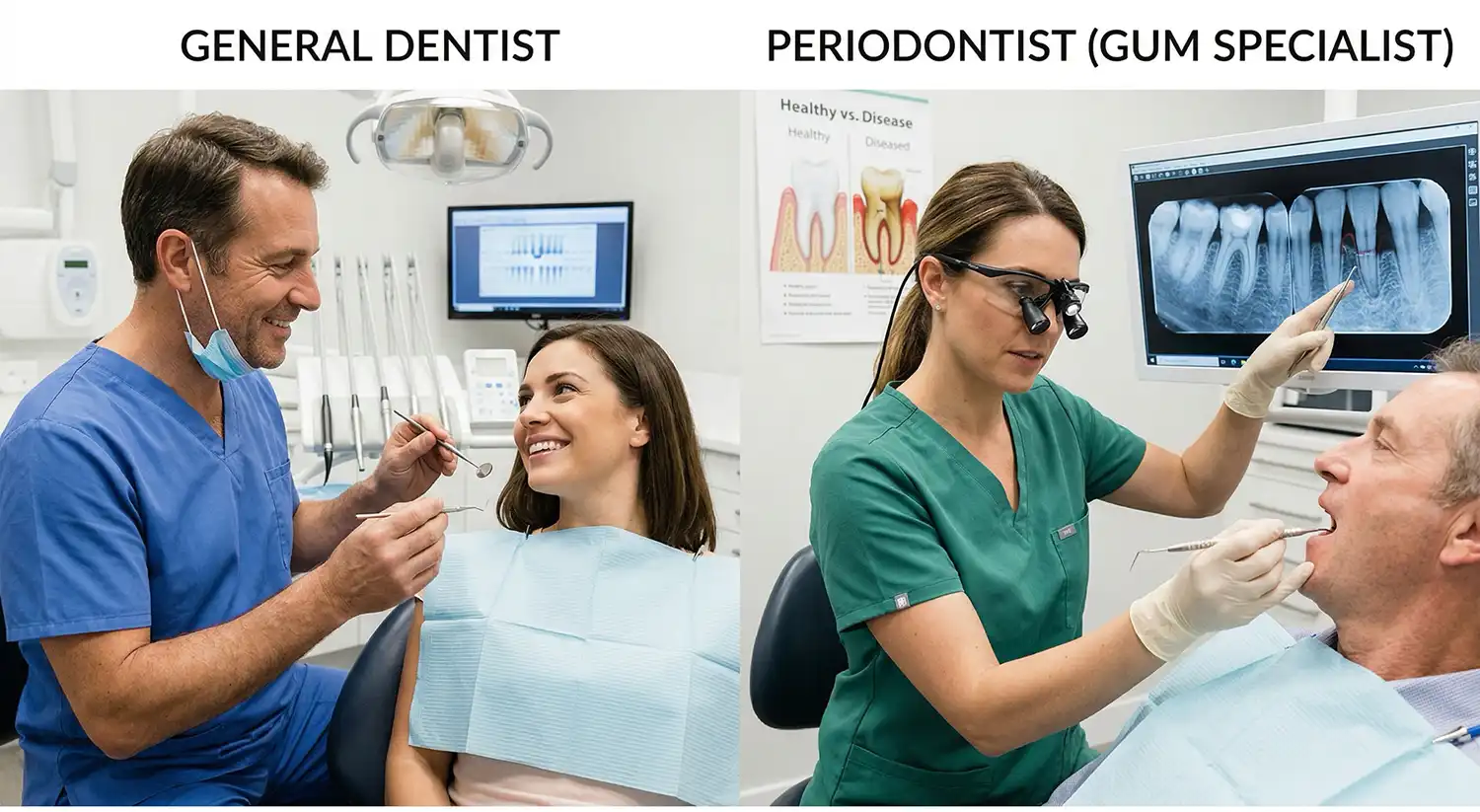
TL;DR Summary
- The General Dentist: Acts as your primary care provider for oral health, focusing mostly on the teeth themselves (cleanings, cavities, crowns).
- The Periodontist: Is a surgical specialist who focuses on the foundation supporting the teeth—the gums and the jawbone.
- When to Switch: If you have advanced gum disease, severe gum recession, need a dental implant, or have an oral sore that won't heal, you need a periodontist.
- The Expert: Dr. Barry Feldner is a Board-Certified Diplomate of the American Board of Periodontology, meaning he has achieved the highest level of specialized training to protect and rebuild your smile's foundation.
When you experience a medical issue, knowing exactly which doctor to call can save you time, stress, and money. If you have a common cold, you visit your primary care physician. But if you have a complex heart condition, your primary doctor will send you to a cardiologist.
The exact same structure exists in dentistry. While a general dentist is vital for keeping your teeth healthy, there are specific times when your oral health requires the advanced, specialized care of a periodontist. If you are experiencing gum issues, wondering who should place your dental implant, or dealing with oral pain, here is how to know who should look at your gums.
What Does a General Dentist Do?
Think of your general dentist as the primary care provider for your mouth. Their primary focus is on the hard structures—the teeth themselves.
You should see your general dentist for routine preventative care and restorative treatments, such as:
- Bi-annual dental cleanings and X-rays.
- Filling cavities and treating tooth decay.
- Placing crowns, bridges, or veneers.
- Basic cosmetic procedures, like teeth whitening.
Your general dentist is an essential partner in your oral health, and we work closely with many excellent general dentists in our community to coordinate your care.
What Does a Periodontist Do?
While dentists focus on the "house" (the teeth), a periodontist focuses strictly on the "foundation" (the gums and jawbone).
Becoming a periodontist requires completing dental school, followed by an additional three years of intensive, specialized surgical residency. We are the experts in diagnosing and treating oral inflammation, performing soft-tissue (gum) surgeries, and safely placing dental implants into the jawbone.
4 Signs You Need to See a Periodontist
You should proactively schedule an appointment with a periodontist if you experience any of the following:
1. Advanced Periodontal (Gum) Disease
If your gums are red, swollen, or bleed when you brush, you likely have gingivitis or periodontal disease. While a general dentist can manage mild gingivitis, advanced periodontal disease causes the gums to pull away from the teeth, creating deep pockets of infection that destroy the underlying bone. Periodontists use specialized, deep-cleaning techniques and therapies to halt this disease and save your teeth.
2. Gum Recession
If your teeth are looking "longer" or you are experiencing severe root sensitivity, your gums are receding. Periodontists can perform precise tissue grafting to cover the exposed roots, literally turning back the clock on your smile and protecting the tooth from decay without using artificial fillings.
3. You Need a Dental Implant
A dental implant requires drilling into the jawbone. Because periodontists are the recognized experts in hard and soft oral tissues, we are uniquely qualified to assess your bone volume, perform necessary bone grafting, and place the implant perfectly so it lasts a lifetime.
4. A Mouth Sore That Won't Heal
Periodontists are also specialists in oral pathology. If you have a red or white patch, a lump, or a sore in your soft tissue that does not heal within two weeks, a periodontist is the right specialist to perform a thorough screening and biopsy.
The "Diplomate" Difference
Do you need a referral to see a periodontist? In most cases, no. You can be your own health advocate and contact a specialist directly.
When choosing a periodontist, credentials matter. As a Board-Certified Diplomate of the American Board of Periodontology, I have voluntarily subjected my surgical skills and medical knowledge to the highest level of peer-reviewed examination in my field. This credential is your guarantee that you are receiving care from a recognized expert who is deeply committed to protecting your health, your comfort, and your smile's foundation.