
TL;DR Summary:
- The Problem: When you lose a tooth, the jawbone underneath naturally begins to shrink away.
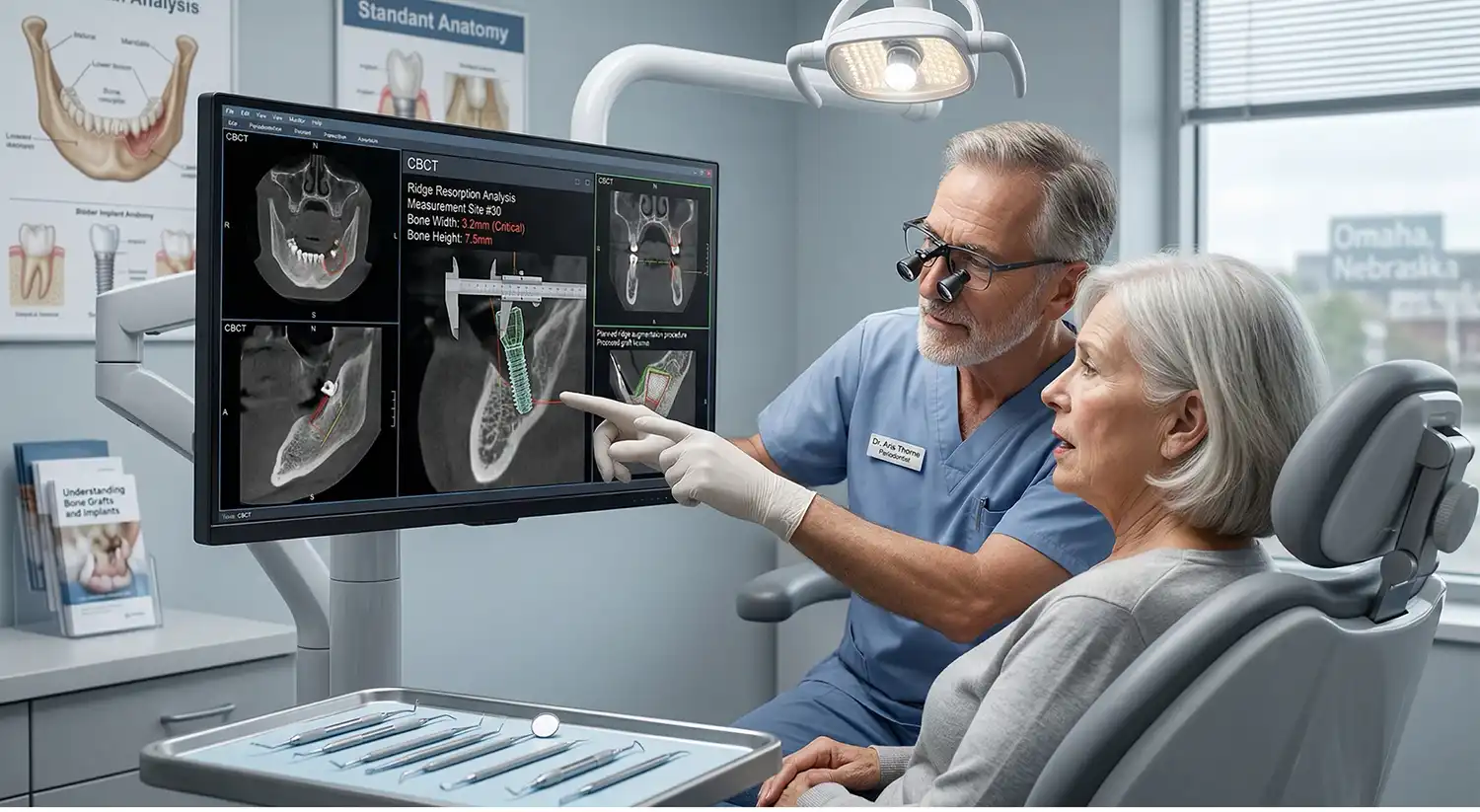
- The Diagnosis: We use advanced 3D imaging (CBCT) to measure your exact bone width and height.
- The Solution: If your bone is too thin for an implant, Dr. Feldner can use targeted bone grafting to rebuild a strong, permanent foundation.
- The Expert: As a Board=Certified Periodontist, Dr. Feldner specializes in preserving and rebuilding the hard and soft tissues of your mouth
If you are considering a dental implant to replace a missing tooth, you are making a fantastic investment in your long-term health. However, one of the most common questions patients ask during their initial consultation is: "Do I actually have enough bone to support it?"
It is a crucial question. Just like you wouldn't build a beautiful custom home on a crumbling foundation, we cannot place a successful dental implant into a weak or thin jawbone. Here is how we evaluate your foundation and what we can do if your bone needs a little help.
Why Does Jawbone Loss Happen?
Your jawbone stays strong and dense because the roots of your natural teeth stimulate it every time you chew. When a tooth is extracted or falls out, that stimulation disappears.
Without a tooth root to support, the body assumes the bone in that area is no longer needed. Almost immediately, the jawbone begins to resorb (melt away), losing both width and height. If you have been missing a tooth for several years, or if the tooth was lost due to advanced gum disease, there is a high probability that some bone loss has occurred.
How Do We Measure Your Bone?
We never guess when it comes to your surgical care. During your evaluation, we use advanced 3D CBCT (Cone Beam Computed Tomography) imaging.
Unlike a traditional flat dental X-ray, a 3D scan allows us to virtually rotate your jaw and measure the exact millimeter width, depth, and density of your bone. It also allows us to map out vital structures, like nerves and sinus cavities, ensuring your implant placement is perfectly precise and completely safe.
What if You Don't Have Enough Bone? The Solution
If your 3D scan reveals that your bone is too thin or too short, do not worry. This does not mean you cannot get an implant; it simply means we need to prepare the site first.
As a periodontist, rebuilding lost bone is one of my core specialties. We use a procedure called bone grafting. During this highly routine process, we place specialized grafting material into the areas where your bone has receded. Over the next few months, your body will naturally heal and fuse with this material, regenerating a solid, robust foundation perfectly sized to hold your new implant securely.
Why Trust a Board-Certified Periodontist?
While many dentists offer implants, periodontists complete three additional years of specialized surgical training focused entirely on the bone and gum tissue.
Furthermore, as a Diplomate of the American Board of Periodontology, I have passed the highest level of peer-reviewed examination in my field. This means you are receiving care from an expert uniquely qualified to manage complex bone reconstruction, ensuring your implant is placed safely and designed to last a lifetime.